Comparison and Form both do the same fundamental thing: they tell you, in as much detail the app can provide, what has already happened:

  • Xavi Simons scored this many.

  • Como conceded that many.

  • Liverpool’s shot volume is 1.4 standard deviations above the La Liga average…. and so on.

That's most of the argument, but it isn't all of it. Many football arguments aren't about what happened. They're about what would happen.

  • Every one of them is a hypothetical:

  • Could that Arsenal side live with this City side?

  • What does Haaland actually do in a Liverpool shirt?

  • Is my best eleven, picked from four leagues, any good?

No amount of historical data answers a hypothetical because the match it describes has never been played. This is where the Simulator helps.

Simulation Modelling

Why existing tools don't answer it

Two kinds of tool already try, and each is built for a slightly different job:

Predictors: Prediction tools need a real fixture to point at. They can tell you something useful about Saturday's match but they can’t tell you anything about how a Liverpool team from 2024/25 might have performed against a PSG team from 2025/26. That match isn't on any fixture list and never will be.

Rating-based simulations: Ratings systems will happily play any match you like, and the good ones are genuinely sophisticated with highly detailed match engines, tactical instruction and squad management.

But they are built to be played.

This means they require every player to be legible as a set of attributes (a figure for finishing; a figure for pace; a figure for composure; etc…). This constrains the data to acting as assessments rather than measures. While they may often be well informed carefully composed (Football Manager’s database is excellent, for example), every result a ratings-based simulation produces ultimately sits downstream of these assessments. That isn't a flaw. It's the right design for a game.

However, it is simply a different question from the one I wanted answered. If the argument is about what a player would actually produce, I'd rather the inputs were things that had been counted than things that had been judged.

What the Football Apptitude Simulator does differently

The Simulator builds the match out of the same per-90 data the rest of the app runs on. No player is handed a rating.

A real player carries his own actual output (e.g.: goals, assists, shots, shots on target, xG, fouls, cards) from his actual team, in his actual league, in his actual season. Those counted rates are the foundation the match is played from, which means the result is traceable: you can always follow it back to the players you picked and what they really did.

Team Selection

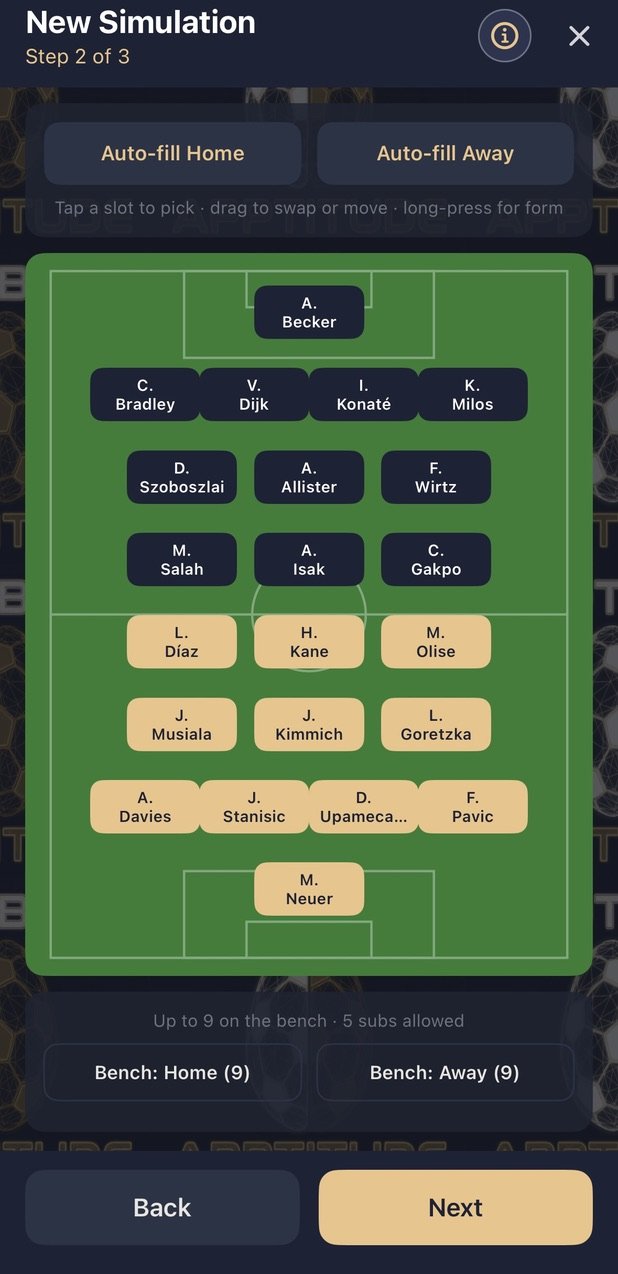
Team selection within the simulator allows you to select from any existing team within the database, or create a completely custom team template based around a chosen league and season. Any team from the supported leagues and seasons can be set against any other: an ordinary fixture, or one that could never appear on a fixture list (e.g.: a Liverpool side from 2024/25 against a PSG side from 2025/26). Alternatively, you can create a team template from scratch using a league and season so you can compare the real impact of players without accounting for team form.

Choose your Starting 11 and Substitutes

Choose from any player in the database: A real player arrives with the genuine stats (e.g.: goals, shots, xG, assists…) that he actually recorded, in his real team, league and season. You are not limited to his club's squad, either: any player in the supported leagues and seasons can be pulled into either side, so a single team can be drawn from several leagues at once.

You can also adjust a real player's form: Every player sits on a dial that moves him up or down relative to the others in his position that season. This is the same z-score logic used across the app. Left alone, the dial changes nothing and you keep his real record. Moved, it plays him through a poor run, or the best spell of his career. You get to use your judgement, laid over his data.

Players not in the database: You can also create a player who is not in the database at all. As custom players have no real data for the app to draw on, the Simulator takes a slightly different approach. Rather than invent numbers for him, the Simulator starts him at the average for his position in the chosen league and season. If you place him in a real team, he also picks up context from that team’s form. Finally, you customise his form using the dial. This allows you to simulate the impact of signings from outside the database with the impact you expect them to have, or create your own wonderkid.

A Match, Not Eleven Solo-Performances

A team's output isn't eleven personal records added together, and the Simulator doesn't treat it that way. Each player's stats are the starting point, but they are used to shape full match simulations:

The Defence You Face Impacts the Outcome: Put your side up against a genuinely good back-four and you create fewer chances against them, just as you create more against a makeshift one.

Midfield Matters: Forwards ahead of a creative midfield get more to finish.

Home Advantage?: Venue matters, and by more than most people would guess. Home advantage isn't a token bump we added because football has home advantage. Instead, it's measured from the same twelve thousand matches as everything else, and it's worth roughly a fifth to a quarter more attacking output for the home side. That makes it one of the biggest single effects in the model and a genuinely tight matchup can swing on nothing more than who's at home.

These are not design decisions. Each was fitted on around twelve thousand real matches, and the player effects had to pass testing before being included. An effect had to show up for the players it should belong to, and fail to show up for the players it shouldn't. If we couldn’t verify an effect then we didn’t allow the Simulator to use it.

The ONLY exception to this was a goalkeeper gate. Nobody in the data ever started a striker in goal, so there is nothing to fit it from. It's the one number set by judgement, and we'd rather tell you that than pretend otherwise. This way, if you want to play Mbappe in goal then he won’t perform like prime Buffon.


Two Kinds of Match

Adjust a real club's line-up and the club anchors the result: Swap one striker into Arsenal and the team doesn't triple its output, because a team's chances mostly come from how it plays, not from any one name on the sheet. This isn’t a restraint we imposed, it's what the data shows. The line-up moves the result at the margin, in the direction and to the degree it moved real results.

Build a side from scratch and there is no club to anchor to: The players are the team. So the Simulator prices each one individually. Here, a player’s own output, position, and form dial anchor against a league-average baseline, and the totals land accordingly.

It Never Flatters Your Customisations

The Simulator won't round your creation toward respectability, and won't rein it in either. Build a genuine “Super Team” and it reads like one. Field eleven forwards and they will score plenty and defend like a sieve. This doesn’t occur as a punishment, but because that's what eleven forwards would do. If you build something that legitimately produces an outrageous score-line, you get the outrageous score-line. The honesty runs in both directions.

Simulation Output

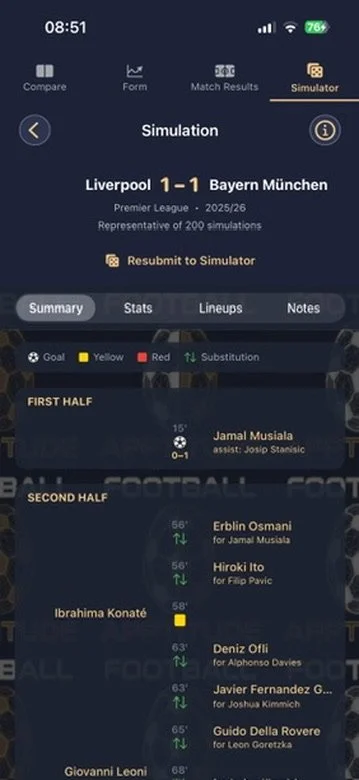
One Simulation is a Match: Run a single simulation and you get a match, not just a score. The Report reads like a match summary: every goal time and any assist, yellow and red cards, substitutions. Goals cluster late, subs arrive in the second half, a red card in the 60th minute changes the hour that follows.

The timing of every event is drawn from when those events actually happen in real matches, and a team down to ten men scores at the rate real ten-man teams score at.

Many Simulations are an Answer: Run two hundred instances of a fixture and you stop looking at one story and start looking at the shape of all of them.

Multiple simulation instances of a fixture provide you with notes covering the most common patterns (e.g.: the most common score-line, who scored in 61 of 200 simulations, who kept getting booked, which substitute kept arriving to change things). The Stats give you every team statistic as a distribution, with an average, spread, and range the middle 80% of simulations landed in.

That range is the honest part. A simulator that hands you one score-line is hiding how uncertain football is. Arsenal 2–1 might be the most likely result and still happen in only a tenth of instances. This is a sport where the better team loses all the time, and the output says so out loud.

You still get a full match report at 200 instances, but it’s compiled honestly. It contains the most common score-line, and within it, a typical run rather than the wildest one. It's labelled as representative, because that's what it is.

NOTE: Ad-Supported user tiers are limited to one-instance simulations.

Checked against reality: Alongside every simulated statistic, the output will show the same stat from the team's real recorded history along with the gap between them. If the simulation says your side takes 19 shots and their real average is 12, you can see that. This will help you decide whether it's your super-team working as intended, or a line-up that's drifted somewhere implausible. The sim grades itself against the record, in the same view.